
Democratic values are being challenged.
It’s time to step in now.
We intervene with strategic value-based communication.
OpenEcho currently runs small field tests together with academic partners and public-interest organisations: research findings become non-confrontational content, delivered to hard-to-reach audiences and measured against a control group.
The same loop can run on any topic where research on the drivers exists: resilience against polarising and extremist narratives, inclusion and equal opportunity, health and science confidence.
Benefits for public-interest organisations:
Engaging with hard-to-reach audiences.
Creating relevance, also with people who have different perspectives.
Demonstrating actual societal outcomes.
What We Do
Impact-communication framework
Impact is not measured in likes or reach, but in actual societal outcomes.
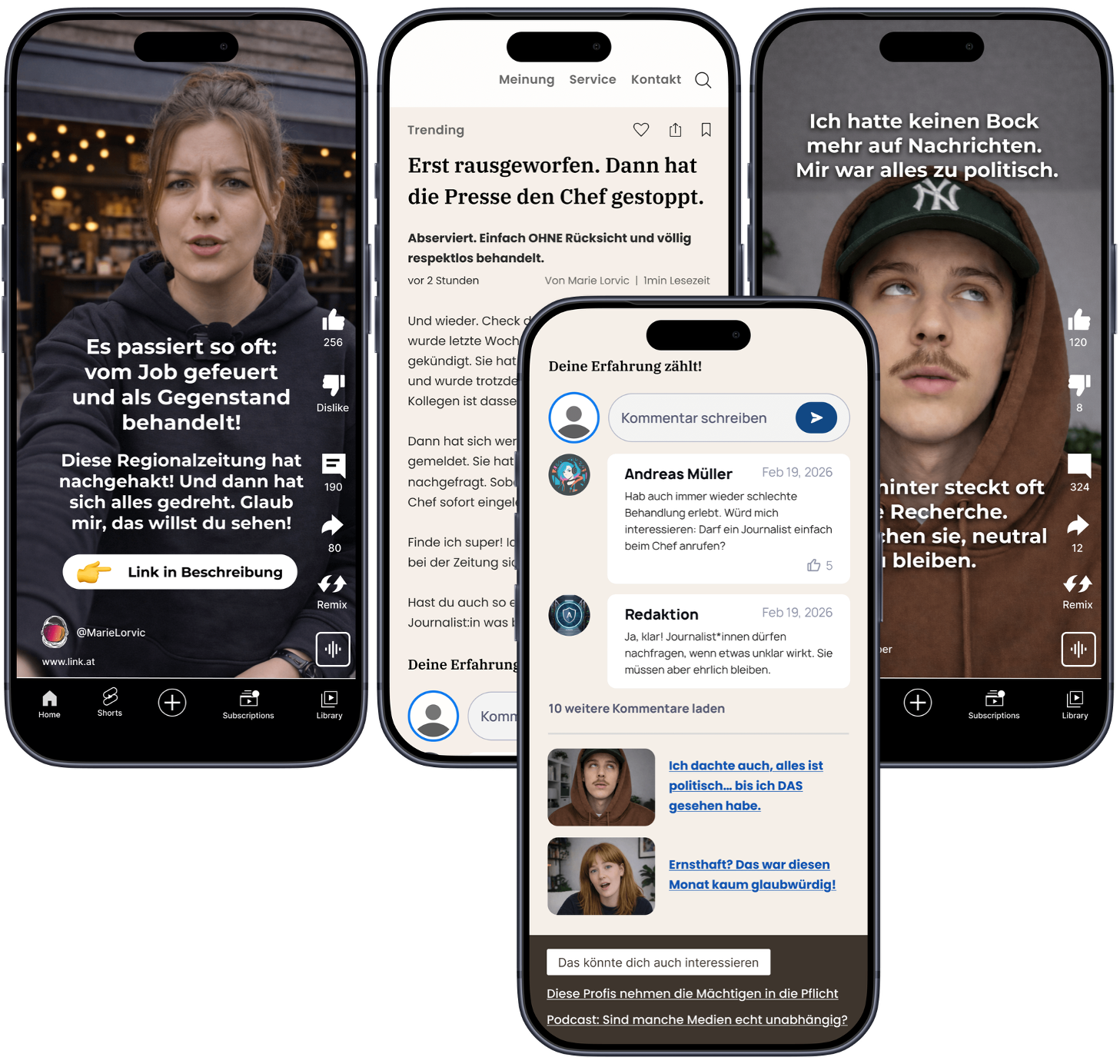
The OpenEcho framework is one loop: research findings become tagged content variants, written to non-confrontational rules. Delivery is randomised against a neutral control, with one short in-flow question measuring what moved. The evidence goes back to research and into the driver library.
The integration of research grounds everything in evidence and keeps it transparent about what works.

Connecting with research and universities.
Academic research delivers important insights on disinformation, FIMI, resilience, platform dynamics and digital literacy.
But a practical challenge remains:
How do we translate these insights into real-world interventions to counter disinformation, deploy to target audiences and measure their impact on democratic and societal resilience?
This is the gap that OpenEcho is designed to address.
Where we are: a first field test is in design to be fielded in Q1 2027. Small on purpose: to get first data in and prove the loop before anything is scaled.
Who we are looking for:
Research partners for the next study designs and for joint funding applications.
Public-interest organisations, broadcasters and NGOs who bring content, creators or channels in kind for a field test.
Foundations and public funders: OpenEcho works as the delivery-and-measurement layer inside a partner’s project, so resilience funding comes with evidence of effect.

We work with partners who share our goals.
Use Case example: Media Trust
Why it matters, and how a resilient society starts with trust.
Media-critical individuals are more likely to turn to alternative sources of information. This makes them more susceptible to disinformation and polarisation, undermines public discourse and weakens democratic institutions. At the World Economic Forum 2025 this was highlighted as key societal risk. Low trust in media and institutions contributes to the problem.
Trust in institutions is declining. Trust in “the media” in Austria is at 38% (2025) and has declined by 12% since pre-Brexit/Trump 10 years ago (Reuters Digital News Report). As comparison: in Germany it’s at 47%. Among younger audiences and people with lower media literacy, trust is even lower (20–25% and 10–15% respectively). Strengthening trust is therefore both urgent and promising.
Research shows: trust increases when media are perceived as independent, transparent, representative and as serving society. Through storytelling, we connect these drivers with topics that are relevant to a young and social-first audience. But trust cannot be forced. Our behavioural approach therefore focuses on small steps and long-term impact, using content that broadens perspectives without confrontation. To what extend research-based and non-confrontational communication can move this at all, is exactly what a field test measures.
Shared values: a better understanding about why the media plays an important role to keep our society fair, makes us more resilient against manipulation and fake news. This contributes to social cohesion, solidarity in online discourse and openness to other perspectives. It reduces scepticism toward media and freedom of information and supports a more resilient democracy.